






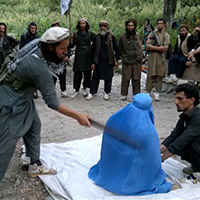

In a renewed and intensified assault on women's freedoms, the Taliban has launched a wave of arbitrary arrests across Afghanistan, targeting women and girls accused of violating the group’s extreme interpretation of hijab rules. Over the past week alone, dozens of women have been detained in Kabul, Herat, and Mazar-e-Sharif, under vague and ever-changing standards of “modesty,” with no due process or legal justification.
These arrests are taking place in public spaces — streets, shopping malls, cafes, and university campuses — where women are simply trying to go about their daily lives. In Kabul, several women were picked up by Taliban forces from the Shahr-e Naw, Dasht-e-Barchi, and Qala-e-Fataullah areas. Witnesses reported that Taliban agents stopped women in marketplaces, detained them for so-called “bad hijab,” and, in some cases, physically assaulted them before forcing them into vehicles. They were held in so-called “morality centers” and only released after their male guardians signed written guarantees to “correct” their behavior.
In Herat, at least 26 women were arrested in recent days, many of them young and some reportedly underage. Taliban officials confirmed the detentions, claiming the women had been warned previously, and justifying the arrests with threats of escalating punishment. These women were taken to facilities run by the Ministry for the Promotion of Virtue and Prevention of Vice — a feared institution that now acts as a religious police force.
Mazar-e-Sharif saw similar scenes when Taliban agents stormed a shopping center and arrested around ten women, accusing them of not covering their faces fully. Those arrested were reportedly held without access to legal representation, family contact, or medical care. Local reports suggest that some families are now too afraid to let their daughters leave home, fearing they could be next.
The United Nations and human rights watchdogs have condemned these arrests, describing them as serious violations of international law and a clear sign of Afghanistan’s descent into gender apartheid. However, the Taliban shows no signs of backing down. Instead, officials from the Ministry have doubled down on their threats, announcing that any woman found to be wearing a “bad hijab” will be punished immediately, without prior warning.
These acts are not about religion — they are about domination. The Taliban is using hijab enforcement as a political weapon to silence and erase women. By criminalizing ordinary clothing choices, they are sending a chilling message: women do not belong in public, and any attempt to assert their presence will be met with force. This is a continuation of the Taliban's systematic dismantling of women's rights, which includes bans on girls’ education beyond sixth grade, prohibitions on women working with NGOs and international organizations, and harsh restrictions on mobility and appearance.
Despite the growing repression, many Afghan women are resisting — refusing to disappear, documenting abuses, and speaking out even at great personal risk. But their voices are being met with indifference from much of the international community. The time for symbolic condemnation has passed. The Taliban’s actions amount to a sustained campaign of gender-based persecution, and they must be treated as such. Without concrete international pressure, the regime will continue its war on women unchecked, emboldened by the silence of a world that once promised to stand with the Afghan people.